Overview of French Phonetic Terminology and Concepts
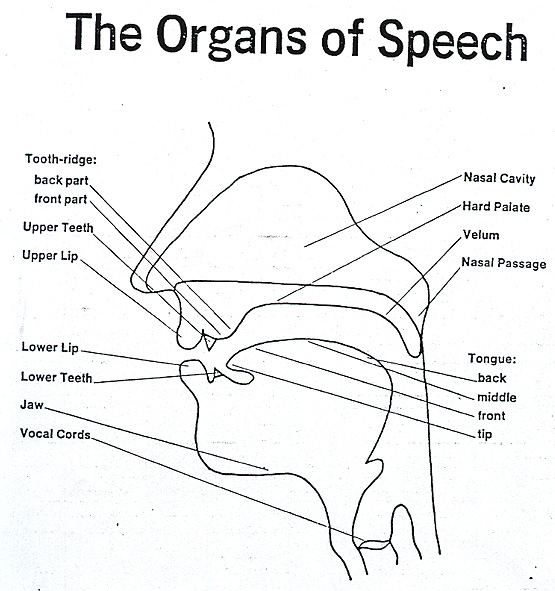
Speech sounds are produced by modifying the airstream that begins in the lungs. These modifications take place in the mouth and involve parts of the body that are used for other functions as well. The main speech organs you should be familiar with are presented in the following diagramme:
The vocal tract
Consonants and Vowels
Speech sounds fall into two general categories: a) consonants and b) vowels. The main difference is that when consonants are produced, the airflow from the lungs is blocked (partially or completely), while the air flows freely during the articulation of a vowel.
Consonants
Let's begin with a general classification of French consonants. We classify consonants according to three main categories: a) manner of articulation (how we modify the airflow); b) place of articulation (where we modify the airflow) and c) voicing (whether or not the vocal chords vibrate).
Manner of articulation
French consonants are articulated in three main ways: a) by stopping the airflow completely, then releasing it. Consonants produced in this manner are referred to as stops (e.g.: /t/, /b/); b) by restricting the airflow, e.g.: with the tongue. Consonants produced in this manner are referred to as fricatives (e.g.: /s/, /f/); and c) by allowing the air to pass by the sides of the tongue, while the tip makes contact behind the upper teeth. Consonants produced in this manner are referred to a laterals (e.g.: /l/).
Nasals
When a nasal consonant is produced, air flows through both the mouth and the nasal cavity. There are three nasal consonants in French: /n/, /m/ and /ɲ/. French nasal consonants are also classified as stops since the air flow is interrupted in the mouth, though flows freely through the nasal passage.
Voicing
One important distinction made between consonants is voicing, which refers to whether or not the vocal chords vibrate during articulation. When producing a voiced consonant, the vocal chords are drawn together and vibrate.
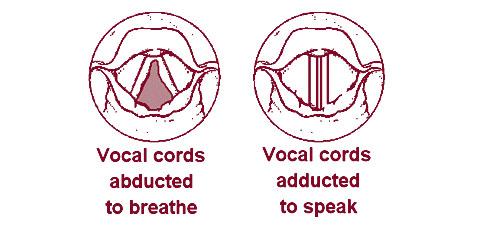
Consider the sounds /b/ and /p/. If you put your finger on your Adam's apple during articulation of these, you'll notice that it only vibrates for /b/. The consonant /b/ is voiced, while /p/ is voiceless.
Place of Articulation
The second way we classify consonants is according to the place in the mouth where the air is blocked or restricted. The relevant places of articulation for French consonants are: the lips, the teeth, the palate, the velum (i.e.: the back part of the palate) and the tongue. Let's examine how we use these when making consonants.
lips: these can be drawn together, e.g.: /b/, /m/ or the bottom lips and touch the top teeth, e.g.: /f/, /v/. Consonants produced with the lips are referred to as labial consonants.
teeth: as mentioned, the top teech can touch the bottom lips, e.g.: /f/, or the tip of the tongue can touch behind the top teeth, e.g: /t/, /s/. Consonants produced with the teeth are referred to as dental consonants.
palate: the blade of the tongue can touch the centre of the palate, e.g.: /ʃ/ as in "cher". Consonants produced with the palate are referred to as palatal consonants.
velum: the back of the tongue can touch the velum, e.g.: /k/, /g/. Consonants produced with the velum are referred to as velar consonants.
Let's now use the classification voicing, place and manner of articulation to classify the consonants of French:
| French consonants |
| |
Stops |
Fricatives |
Nasals |
Laterals |
| |
Voiceless |
Voiced |
Voiceless |
Voiced |
Voiced |
Voiced |
| Bilabial |
/p/ |
/p/ |
|
|
/m/ |
|
| Labio-dental |
|
|
/f/ |
/v/ |
|
|
| (apico-)Dental |
/t/ |
/d/ |
/s/ |
/z/ |
/n/ |
/l/ |
| Palatal |
|
|
/ʃ/ |
/ʒ/ |
|
|
| Velar |
/k/ |
/g/ |
|
/ʁ/ |
|
|
As we see in the above chart, all French consonants can described using this classification system, e.g.:
/p/ is a voiceless, bilabial, stop.
/z/ is a voiced, (apico-) dental, fricative.
French Vowels
The system used to classify French vowels is different from the one used for consonants (dont' confuse them!). The main criteria for describing vowels are: a) vertical tongue position (i.e.: how high is it?); b) horizontal tongue position (front versus back); c) lip rounding; d) whether or not air also passes through the nasal cavity. Let' consider each of these in turn.
Vertical Position of the Tongue
The tongue can move higher or lower in the mouth. Doing so changes the shape of the opening through which air flows and, in turn, changes the type of vowel produced. Our description of French vowels will use four levels of tongue height: high, mid-high, mid-low and low. Consider for example the vowel /i/ in the word "si". When you pronounce this vowel, you'll notice that the tongue is relatively high in the mouth. Since the tongue is high, the passage between the tongue and the palate is relatively closed (or narrow). High vowels are sometimes referred to as "closed" vowel because of this. French has three high vowels: /i/, /y/, /u/.
Horizontal Position of the Tongue
Just as the tongue can move up and down, so too can it move from the front to the back of the mouth. As such, three horizonal positions can be identified: front, central and back.
Lip Rounding
French vowels are either rounded or unrounded. This means that the lips. It is important to note that when a French rounded vowel is articulated, the lips are advanced (or protruding) as well as rounded. The position is more or less that same as when someone whistles. Always keep this in mind when articulated a rounded vowel in French.
Nasal versus Oral
Unlike English, French has a series of nasal vowels: /ã/, /õ/, /ɛ̃/, /œ̃/. When a nasal vowel is pronounced, the velum is slighly lowered so that air passes though both the oral cavity AND the nasal cavity.
The following charts show how these features can be used to describe any French vowel:
| Oral Vowels |
| |
Front |
Central |
Back |
| |
unrounded |
rounded |
unrounded |
rounded |
| high (closed) |
/i/ |
/y/ |
|
/u/ |
| mi-high |
/e/ |
/ø/ |
|
/o/ |
| mid-low |
/ɛ/ |
/œ/ |
|
/ɔ/ |
| low (open) |
|
|
/a/ |
|
| Nasal Vowels |
| |
Front |
Back |
| |
unrounded |
rounded |
unrounded |
rounded |
| high (closed) |
|
|
|
|
| mid |
/ɛ̃/ |
/œ̃/ |
|
/õ/ |
| low (open) |
|
|
/ã/ |
|
For example,
/i/ is a: high, front, unrounded, oral vowel
/ɛ̃/ is a: mid, front, unrounded, nasal vowel.
 BonPatron